
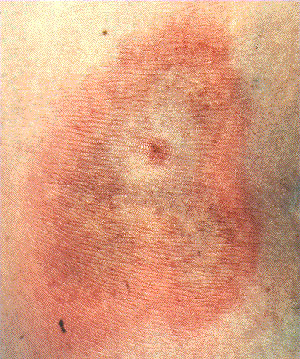
 We do lots of walking across a variety of terrains where we cannot always see whats underfoot. It is only certain infected ticks that bite and are not noticed clinging on to your skin, that usually cause Lyme disease. However, ticks are very small and often do not hurt when they bite. BBC magazine monitor recently featured a timely reminder – see . It is quite easy to have a tick bite without noticing, eg on your leg or back. Many people developing symptoms cannot remember being bitten by a tick.
Further reading
- BBC Monitor article
- Tick Alert
- Lyme Disease from patient.info – an extract from the page is included below
Tick Bites and Lyme Disease from patient.info
You can read the full article on the link above
Lyme disease prevention
The following will reduce the risk of developing Lyme disease:
- If possible, avoid wooded areas where infected ticks live - particularly in the summer months. When out in the countryside, keep to paths and away from long grass or overgrown vegetation, as ticks crawl up long grass in their search for a feed.
- If living in or visiting a tick-prone area, wear appropriate clothing when outdoors, ie long-sleeved shirts and long trousers tucked into socks. Light-coloured fabrics are useful, as it is easier to see ticks against a light background.
- Inspect your entire body each day to check for ticks and remove any that are on the skin. Make sure that children's head and neck areas, including scalps, are properly checked.
- Consider using an insect repellent spray, cream, etc, on the skin to help avoid tick bites (such as one that contains N,N-diethyl-m-toluamide (DEET)).
- Shower or bath after returning from a tick-infested area.
- Check that ticks are not brought home on clothes.
- Check that pets do not bring ticks into the home on their fur.
Risk factors
Many people affected are forestry workers and other outdoor workers but visitors and holidaymakers to countryside areas where ticks are found are at risk.
Over half of infections acquired in the UK are known to have been caught in the southern counties of England. Areas where it is most common tend to be centres of outdoor activity - in particular, the New Forest, Thetford Forest, the South Downs, Exmoor, the Lake District, the North York moors and the Scottish Highlands.
Up to a fifth of Lyme disease is caught while abroad, in particular, the USA, France, Germany, Austria, Scandinavia and eastern and central Europe.
How to remove a tick that is attached to your skin
Ticks attached to the skin can be removed by:
- Gently gripping the tick as close to the point of attachment to the skin as possible. Do this preferably using fine-toothed tweezers or forceps, or a tick removal device.
- Pulling steadily upwards, away from the skin. Take care not to crush the tick.
- Inexpensive tick removal devices may be available at veterinary surgeries and pet supply shops and are useful for people who are frequently exposed to ticks. These should be used in accordance with manufacturers' instructions.
Do NOT do any of the following:
- Burn the tick off (for example, using lighted cigarette ends or match heads).
- Apply petroleum jelly, alcohol, nail varnish remover, or other substances (as this may stimulate the tick to regurgitate potentially infected material into the skin, which may increase the risk of transmission of infection).
- Use your fingers to pull the tick off.
- Squeeze or crush the tick.
After removal, DO clean the skin with soap and water, or skin disinfectant, and wash hands.